

JAPANESE BUSINESS ETIQUETTE
CHOPSTICK MANNERS:
- Do not rest chopsticks by sticking them point-first into your food, especially rice.
- Do not pass food with your chopsticks directly to somebody else's chopsticks.
- Do not move around plates or bowls with chopsticks.
- Do not spear food with your chopsticks.
- Do not hover your chopsticks around while deciding on which food to pick.
- Do not touch one dish and immediately move on to another.
- Do not lick your chopstick or hold them in your mouth
- Do not lay them on the edge of your bowl or plate
DON'TS IN BUSINESS
- If you are late, it’s important to apologize; the greater the inconvenience, the more ways you should demonstrate your regret
- If you must cancel the meeting, deeply apologize and suggest an alternative date or solution
- Be a rude communicator
- Be sarcastic
DO'S IN BUSINESS
- Keep in mind that your appearance count
- Keep your hair and clothing tidy and in good condition
- Get anti-mildew stuff for your closet
- Get a fan to blow air through your closet for drying clothing
- The amount of care you put into your appearance reflects how much care you will put into the relationship
- Keep your apartment clean and in good shape for your sanity and to increase your social options
- Thank people graciously
- Ask questions politely
- People love to share information about themselves and their culture
- Be comfortable with silence
- Bring a stash of Western goodies just in case
JAPANESE BUSINESS CARDS
- In Japanese business etiquette, Japanese business cards are a 'must have'. Carry at least 100 for a one-week business trip to Japan and expect to give out 3 - 4 Japanese business cards at a small meeting and as many as 10 - 12 at a larger meeting. Have double-sided Japanese business cards printed with the Japanese language side being custom designed using the same elements as the English side. If your original business card is not English (i.e. German, French, Spanish etc.) then use double-sided English and Japanese business cards when doing business in Japan
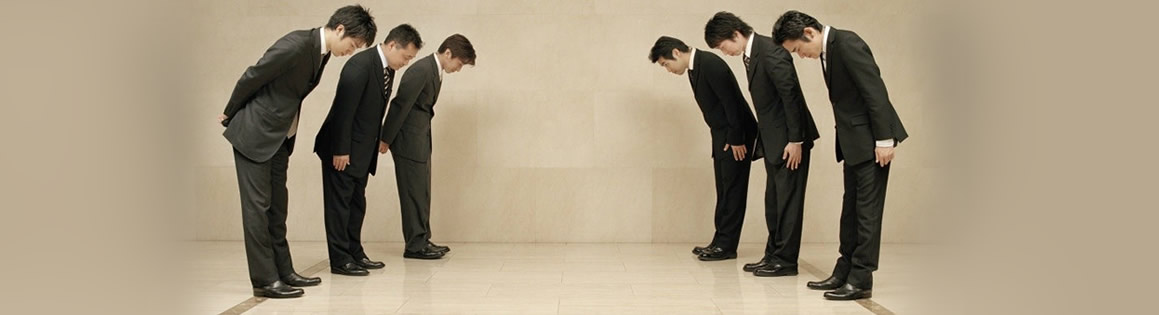
- Never flick, throw, slide, lob or otherwise push your Japanese business card across the table - always present your Japanese business card holding it with both hands, Japanese-language side facing forward (having your company logo at the top of the Japanese-language side will help you orientate it correctly!), to the most senior member of the Japanese party first, bowing slightly as you do so and then on down the corporate ladder
- Accept a Japanese business card with respect, using both hands, saying 'thank you' as you do so
- Never write notes on a Japanese business card - never! Carry a small note book to write down notes or enter them into your PDA
- Never fidget or play with a Japanese business card
- Keep your Japanese business cards in a proper carrying case and treat them with respect
- Remember to deliberately and carefully pick up all of the Japanese business cards you receive and put them into your case at the end of the meeting. Forgetting his business card is a slap in the face to a salaryman - it says you did not consider him to be relevant. You probably get the idea that Japanese business cards are important!
BUSINESS ATTIRE:
Men: Japanese business etiquette may be getting less formal but business attire does not seem to be changing. Wear dark suits (navy or black) with white shirt and subdued tie from October - April and gray suit from May - September. Japanese summers are hot and humid and most Japanese men wear half-sleeve shirts during the summer months. Do not wear black suit, white shirt and black tie because that is funeral attire. Japanese men typically have well-groomed short hairstyles but if you are the president of a company then a pony-tail may be acceptable. Japanese companies do not allow male employees to wear beards nor to shave their heads. Of course your attire is not complete without your Japanese business cards!
Women: Although not so much an aspect of Japanese business etiquette as of culture, many Japanese men do not relate easily to women with authority in business and that can present problems for women executives from the US and Europe. To avoid being treated as an 'office-lady', you are recommended to wear shorter (or tied back) hair, trouser suits or longer skirt suits with seasonal colors as for men. Japanese women are very fashion conscious and many wear Gucci, Chanel, Prada etc. outfits to and from work (although most companies require their female staff to wear company uniform while working). Most Japanese companies do not allow female employees to wear jewelry, very short skirts or high-heeled shoes. Women too are not properly attired without Japanese business cards!
BUSINESS MEETINGS:
- Not strictly Japanese business etiquette but always make a call 1- 2 hours prior to a scheduled meeting to confirm that you are on your way
- If you will be late arriving for a meeting, then call at least one hour in advance to allow the customer to reschedule
- Always arrive 10 minutes early for a meeting, more if the meeting will be with senior executives
- Plan an exact agenda for the meeting - if the Japanese side say the meeting will finish at 4 pm then it probably will not be extended because employees and facilities often run on tight schedules
- Wait to be seated in the meeting room because there is a custom regarding which party sits on which physical side of the table
- It is good Japanese business etiquette to take lots of notes - it indicates interest and Japanese are trained during induction to note down everything at meetings. If you forget a discount that you promised in an early meeting, even a year later the Japanese side will show you the note they made at the time
- If you need a non-disclosure agreement signed send it well in advance of the meeting. Many companies here do business without written contracts and are wary of foreign company contracts best swiss watches replica because of horror-stories they hear about litigation. If you suddenly slap a non-disclosure agreement on the table at a first meeting, the Japanese side will be embarrassed, probably refuse to sign it until it has been legally reviewed and avoid meeting again
PERSONAL HABITS:
- Do not blow your nose in a public place (including meeting rooms)
- Do not grab your host's hand when first meeting and give it a hearty shake - many Japanese seldom shake hands and can be so uncomfortable doing so as to avoid meeting again
- Never pat a Japanese man on the back or shoulder
- Never make derogatory remarks about anyone, including your competitors and own employees
- Always smile, be pleasant, and be willing to learn, ask a lot of questions about your customer’s company but none about his/her private life
- Attend to personal grooming in public
- Mints are better than chewing gum; you can bring a toothbrush around if you need
- Do your makeup in the bathroom
- Yawning is considered a bad habit
- Fidgeting or shaking legs comes off as childish
