

CULTURE OF JAPAN
The culture of this island nation located in the Pacific Ocean absorbs influences from Asia, Europe and North America.LANGUAGE
The official language of the country is Japanese, which is written with a combination of three scripts _ hiragana, derived from the Chinese cursive script, katakana, derived as a shorthand from Chinese characters, and kanji, imported from China. Hindu-Arabic numerals are used for numbers while the traditional Sino-Japanese numerals are also common.
LITERATURE
One can see the influence of Chinese literature in the early works of Japanese literature. Also, Indian literature had an influence through the diffusion of Buddhism in Japan. Eventually, Japanese literature developed into a separate style.
MUSIC
The traditional music of Japan, which is based on the intervals of human breathing rather than mathematical timing, differs from the Western style. Local music often appears at karaoke venues, which is on lease from the record labels. This apart, painting too has been an art in Japan for a quite a long time.
CALLIGRAPHY
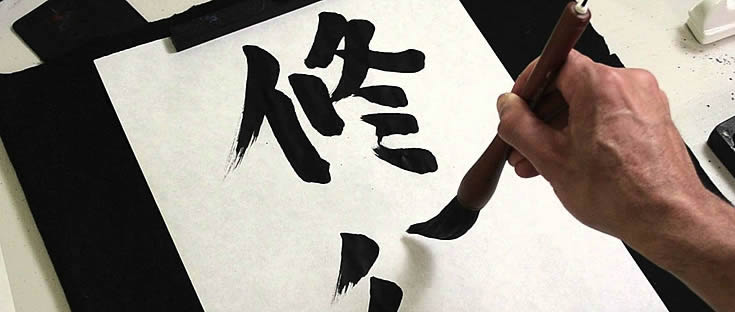
Calligraphy, the brush-drawn Japanese rendering of text is seen as a traditional art form. It is also a means of conveying written information. The written work may consist of phrases, poems, stories or even single characters.
SCULPTURES, IKEBANA
When it comes to traditional Japanese sculptures, they are mainly focused on Buddhist images. The statues are often lacquered, gilded, or brightly painted. Wood is the key building material, metals, including bronze are also used.
Ikebana is the Japanese art of floral arrangement which is reputed for its focus on harmony, colour and design.
The four traditional theatres from Japan are noh, kyōgen, kabuki, and bunraku.
ARCHITECTURE
In the beginning, Japanese architecture was heavily influenced by Chinese architecture. However, it has later developed many differences and aspects which are indigenous to Japan. The temples, Shinto shrines, and castles in Kyoto and Nara stand testimonials for the traditional architecture. In Japan, garden architecture is equally important as building architecture. In Japan, the garden has the status of artwork and traditional gardens are influenced from Zen ideas.
DRESSING STYLE
Kimono is the traditional garment of Japan. The earliest kimonos were heavily influenced by traditional Han Chinese clothing. The kimono worn by a married woman (tomesode) differs from that of a woman who is unmarried (furisode). The style of kimono also changes with the season. For instance, in spring kimonos are vibrantly colored with springtime flowers embroidered on them. Uchikake, a long silk over garment worn by the bride in a wedding ceremony, is one among the more elegant kimonos.
During a formal event, a Japanese man might wear the haori and hakama, a half coat and divided skirt. Yukata is a simpler version of kimono often worn in Japanese summer festival. Happi, a straight sleeved coat, is another type of traditional clothing.
FOOD
Popular dishes in Japan include sushi, tempura, noodles and teriyaki. The Japanese diet consists mainly of rice, fresh seafood and pickled or boiled vegetables. The healthy Japanese diet is often believed to be related to the longevity of the people of this country.
MARTIAL ARTS & SPORTS
Methods used to train warriors by the Samurai class were developed into well-ordered martial arts. In modern times, they are collectively referred to as koryū, which comprises kenjutsu, kendo, kyūdō, sōjutsu, jujutsu, sumo etc. Some martial arts later changed into modern sports, called gendai budō. For instance, Judo was developed by Kanō Jigorō, who studied some sects of jujutsu.
Baseball and football are the most popular sports in Japan. Baseball, Association football are commonly practiced in schools, along with traditional martial arts.
ENTERTAINMENT
Japanese popular culture mirrors the attitudes of the current period as well as the past. Movies, television programmes, manga, music and video games are developed from older artistic and literary traditions. Many anime and manga are very popular around the world. Popular hangout places for Japanese teens include game centers, bowling alleys and karaoke while older generation may visit specialised parlors or play shogi.
